Is It Better to Turn Heat Down and Then Up Again or Keep a Consistent Heat
The original question: I'm having a debate with my wife that I think you can assistance u.s.a. resolve. We take a swimming pool in our back yard. Information technology has an electric heater, which nosotros fix to keep the pool water at 85 degrees Fahrenheit. We're going to be away for three days. My married woman says we should turn the heater off while we're abroad to salve energy. I say that information technology takes less energy to maintain the pool at 85 while we're away then to permit information technology drib about ten degrees (summer evenings tin get quite cool where we alive in upstate New York) then use the heater to restore 85. Who's right? And what variables are relevant to the calculation? The average temperature for the iii days? The book of the pool? The efficiency of the heater?
Physicist: The correct answer is always to exit the heater off for as long every bit possible, as often as possible. The one and only proceeds from leaving a pool heater on is that information technology will be warm when yous get in. The same is truthful of all heaters (puddle, car, space, whatever).
You can gain a lot of intuition for how rut flows from place to identify past imagining it as a agglomeration of "heat beads", randomly skittering through thing. Each bead rolls independently from place to place, continuously changing direction, and the more beads there are in a given place, the hotter it is.
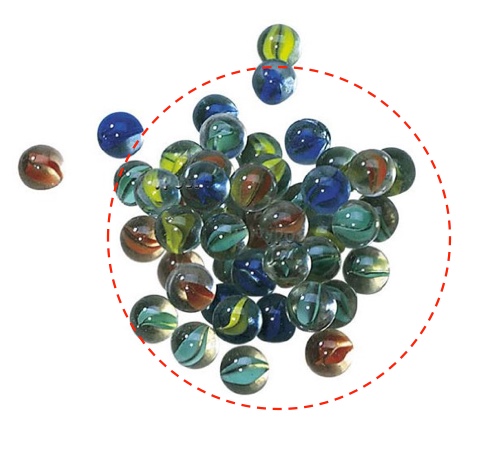
If all of these marbles started to randomly curlicue effectually, more would roll out of the circle than roll in. Rut menstruation works the same way: hotter to cooler.
Although heat definitely does not take the form of discrete chunks of energy meandering most, this metaphor is remarkably proficient. Yous can actually derive useful math from it, which is a damn sight better than nigh scientific discipline metaphors (Eastward.grand., "infinite is similar a safety sheet" is not useful for bodily astrophysicists). In very much the same way that a concentrated collection of beads will spread themselves uniformly, hot things will lose oestrus free energy to the surrounding cooler surroundings. If the temperature of the pool and the air above it are equal, then the amount of heat that flows out of the puddle is equal to the amount that flows in. Just if the pool is hotter, and then more "chaplet" will randomly roll out than randomly roll in.
A difference in temperature leads to a cyberspace flow of oestrus energy. In fact, the relationship is every bit unproblematic every bit it can (reasonably) get: the rate of rut transfer is proportional to the difference in temperature. So, if the surrounding air is threescore°, so an fourscore° pool will shed heat energy twice as fast as a 70° pool. This is why coffee/tea/soup will exist hot for a piddling while, only tepid for a long time; it cools faster when it'southward hotter.
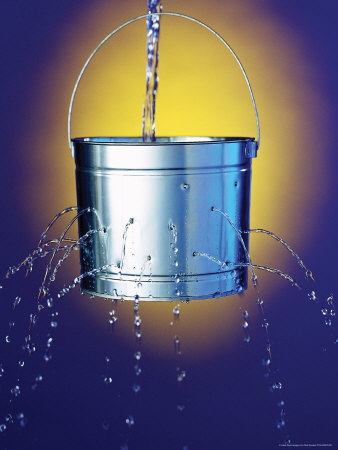
In a holy saucepan, the college the water level, the faster the h2o flows out. Differences in temperature work the same way. The greater the difference in temperature, the faster the heat flows out.
Ultimately, the amount of energy that a heater puts into the pool is equal to the heat lost from the pool. Since you lose more heat free energy from a hot pool than from a cool pool, the most efficient thing you lot can practice is keep the temperature every bit depression as possible for as long equally possible. The most energy efficient thing to do is always to plow off the heater. The only reason to keep it on is so that y'all don't have to wait for the water to warm upwardly earlier y'all utilise it.
It seems as though a bunch of water is a good place to store rut energy, simply the more time something spends being hot, the more energy it drains into everything around it.
Reply Gravy: This gravy is simply to delve into why picturing heat menstruation in terms of the random motility of hypothetical particles is a expert idea. It's well worth taking a stroll through statistical mechanics every at present and again.
The diffusion of heat is governed, non surprisingly, by the "improvidence equation".

The same equation describes the random motion of particles. If ρ(10,t) is the amount of heat at whatsoever given location, x, and fourth dimension, t, then the diffusion equation tells you lot how that estrus will change over time. On the other paw, if ρ is either the density of "beads" or the probability of finding a bead at a particular identify (if the motion of the beads is independent, then these two situations are interchangeable), then once again the diffusion equation describes how the bead density changes over time. This is why the idea of "heat beads" is a useful intuition to use; the aforementioned math that describes the random movement of particles besides describes how heat spreads through materials.
In one of his terribly clever 1905 papers, Einstein described how the random motion of individual atoms gives ascension to diffusion. The thought is to wait at ρ(x,t) so figure outρ(x,t+τ), which is what it will be ane small-scale time footstep, τ, later. If y'all put a particle down somewhere, wait τ seconds and check where information technology is over and over, then you can figure out the probability of the particle drifting some altitude, ε. Just to requite it a proper name, call that probability ϕ(ε).
ϕ(ε) is a recipe for figuring out how ρ(10,t) changes over time. The probability that the particle volition end upwardly at, say, x=5 is equal to the probability that information technology was at x=3 times ϕ(2) plus the probability that it was at 10=ane times ϕ(iv) plus the probability that information technology was at 10=8 times ϕ(-3) and and so on, for every number. Adding upwards the probabilities from every possible starting position is the sort of thing integrals were made for:

Then far this is standard probability fare. Einstein'south beautiful play a trick on was to say "Listen, I don't know what ϕ(ε) is, only I know it'southward symmetrical and it's some kind of probability matter, which is pretty good, amirite?".
ρ(x,t) varies smoothly (particles don't teleport) which ways ρ(x,t) tin be expanded into a Taylor serial in 10 or t. That looks similar:

and

where "…" are the higher lodge terms, that are all very small every bit long every bit τ and ε are pocket-sized.Plugging the expansion ofρ(ten+ε,t) into 
![\begin{array}{ll}&\int\left[\rho(x,t)+\epsilon\frac{d}{dx}\rho(x,t)+\frac{\epsilon^2}{2}\frac{d^2}{dx^2}\rho(x,t)+\ldots\right]\phi(-\epsilon)d\epsilon\\[2mm]=&\rho(x,t)\int\phi(-\epsilon)d\epsilon+\frac{d}{dx}\rho(x,t)\int\epsilon\phi(-\epsilon)d\epsilon+\frac{d^2}{dx^2}\rho(x,t)\int\frac{\epsilon^2}{2}\phi(-\epsilon)d\epsilon+\ldots\\[2mm]=&\rho(x,t)+\left[\int\frac{\epsilon^2}{2}\phi(-\epsilon)d\epsilon\right]\frac{d^2}{dx^2}\rho(x,t)+\ldots\end{array}](https://s0.wp.com/latex.php?latex=%5Cbegin%7Barray%7D%7Bll%7D%26%5Cint%5Cleft%5B%5Crho%28x%2Ct%29%2B%5Cepsilon%5Cfrac%7Bd%7D%7Bdx%7D%5Crho%28x%2Ct%29%2B%5Cfrac%7B%5Cepsilon%5E2%7D%7B2%7D%5Cfrac%7Bd%5E2%7D%7Bdx%5E2%7D%5Crho%28x%2Ct%29%2B%5Cldots%5Cright%5D%5Cphi%28-%5Cepsilon%29d%5Cepsilon%5C%5C%5B2mm%5D%3D%26%5Crho%28x%2Ct%29%5Cint%5Cphi%28-%5Cepsilon%29d%5Cepsilon%2B%5Cfrac%7Bd%7D%7Bdx%7D%5Crho%28x%2Ct%29%5Cint%5Cepsilon%5Cphi%28-%5Cepsilon%29d%5Cepsilon%2B%5Cfrac%7Bd%5E2%7D%7Bdx%5E2%7D%5Crho%28x%2Ct%29%5Cint%5Cfrac%7B%5Cepsilon%5E2%7D%7B2%7D%5Cphi%28-%5Cepsilon%29d%5Cepsilon%2B%5Cldots%5C%5C%5B2mm%5D%3D%26%5Crho%28x%2Ct%29%2B%5Cleft%5B%5Cint%5Cfrac%7B%5Cepsilon%5E2%7D%7B2%7D%5Cphi%28-%5Cepsilon%29d%5Cepsilon%5Cright%5D%5Cfrac%7Bd%5E2%7D%7Bdx%5E2%7D%5Crho%28x%2Ct%29%2B%5Cldots%5Cend%7Barray%7D&bg=ffffff&fg=000000&s=0 "\begin{array}{ll}&\int\left[\rho(x,t)+\epsilon\frac{d}{dx}\rho(x,t)+\frac{\epsilon^2}{2}\frac{d^2}{dx^2}\rho(x,t)+\ldots\right]\phi(-\epsilon)d\epsilon\\[2mm]=&\rho(x,t)\int\phi(-\epsilon)d\epsilon+\frac{d}{dx}\rho(x,t)\int\epsilon\phi(-\epsilon)d\epsilon+\frac{d^2}{dx^2}\rho(x,t)\int\frac{\epsilon^2}{2}\phi(-\epsilon)d\epsilon+\ldots\\[2mm]=&\rho(x,t)+\left[\int\frac{\epsilon^2}{2}\phi(-\epsilon)d\epsilon\right]\frac{d^2}{dx^2}\rho(x,t)+\ldots\end{array}")
Einstein'south cute tricks both showed upward in that final line. 

Then,
![\begin{array}{rcl}\rho(x,t)+\tau\frac{d}{dt}\rho(x,t)+\ldots&=&\rho(x,t)+\left[\int\frac{\epsilon^2}{2}\phi(-\epsilon)d\epsilon\right]\frac{d^2}{dx^2}\rho(x,t)+\ldots\\[2mm]\tau\frac{d}{dt}\rho(x,t)&=&\left[\int\frac{\epsilon^2}{2}\phi(-\epsilon)d\epsilon\right]\frac{d^2}{dx^2}\rho(x,t)+\ldots\\[2mm]\frac{d}{dt}\rho(x,t)&=&\left[\int\frac{\epsilon^2}{2\tau}\phi(-\epsilon)d\epsilon\right]\frac{d^2}{dx^2}\rho(x,t)+\ldots\\[2mm]\end{array}](https://s0.wp.com/latex.php?latex=%5Cbegin%7Barray%7D%7Brcl%7D%5Crho%28x%2Ct%29%2B%5Ctau%5Cfrac%7Bd%7D%7Bdt%7D%5Crho%28x%2Ct%29%2B%5Cldots%26%3D%26%5Crho%28x%2Ct%29%2B%5Cleft%5B%5Cint%5Cfrac%7B%5Cepsilon%5E2%7D%7B2%7D%5Cphi%28-%5Cepsilon%29d%5Cepsilon%5Cright%5D%5Cfrac%7Bd%5E2%7D%7Bdx%5E2%7D%5Crho%28x%2Ct%29%2B%5Cldots%5C%5C%5B2mm%5D%5Ctau%5Cfrac%7Bd%7D%7Bdt%7D%5Crho%28x%2Ct%29%26%3D%26%5Cleft%5B%5Cint%5Cfrac%7B%5Cepsilon%5E2%7D%7B2%7D%5Cphi%28-%5Cepsilon%29d%5Cepsilon%5Cright%5D%5Cfrac%7Bd%5E2%7D%7Bdx%5E2%7D%5Crho%28x%2Ct%29%2B%5Cldots%5C%5C%5B2mm%5D%5Cfrac%7Bd%7D%7Bdt%7D%5Crho%28x%2Ct%29%26%3D%26%5Cleft%5B%5Cint%5Cfrac%7B%5Cepsilon%5E2%7D%7B2%5Ctau%7D%5Cphi%28-%5Cepsilon%29d%5Cepsilon%5Cright%5D%5Cfrac%7Bd%5E2%7D%7Bdx%5E2%7D%5Crho%28x%2Ct%29%2B%5Cldots%5C%5C%5B2mm%5D%5Cend%7Barray%7D&bg=ffffff&fg=000000&s=0 "\begin{array}{rcl}\rho(x,t)+\tau\frac{d}{dt}\rho(x,t)+\ldots&=&\rho(x,t)+\left[\int\frac{\epsilon^2}{2}\phi(-\epsilon)d\epsilon\right]\frac{d^2}{dx^2}\rho(x,t)+\ldots\\[2mm]\tau\frac{d}{dt}\rho(x,t)&=&\left[\int\frac{\epsilon^2}{2}\phi(-\epsilon)d\epsilon\right]\frac{d^2}{dx^2}\rho(x,t)+\ldots\\[2mm]\frac{d}{dt}\rho(x,t)&=&\left[\int\frac{\epsilon^2}{2\tau}\phi(-\epsilon)d\epsilon\right]\frac{d^2}{dx^2}\rho(x,t)+\ldots\\[2mm]\end{array}")
To brand the leap from discrete time steps to continuous time, we just permit the fourth dimension step, τ, shrink to zero (which too forces the distances involved, ε, to shrink since there's less time to get anywhere). As τ and ε become very small, the higher club terms dwindle away and nosotros're left with ![\frac{d}{dt}\rho(x,t)=\left[\int\frac{\epsilon^2}{2\tau}\phi(-\epsilon)d\epsilon\right]\frac{d^2}{dx^2}\rho(x,t)](https://s0.wp.com/latex.php?latex=%5Cfrac%7Bd%7D%7Bdt%7D%5Crho%28x%2Ct%29%3D%5Cleft%5B%5Cint%5Cfrac%7B%5Cepsilon%5E2%7D%7B2%5Ctau%7D%5Cphi%28-%5Cepsilon%29d%5Cepsilon%5Cright%5D%5Cfrac%7Bd%5E2%7D%7Bdx%5E2%7D%5Crho%28x%2Ct%29&bg=ffffff&fg=000000&s=0 "\frac{d}{dt}\rho(x,t)=\left[\int\frac{\epsilon^2}{2\tau}\phi(-\epsilon)d\epsilon\right]\frac{d^2}{dx^2}\rho(x,t)")

The second derivative, 
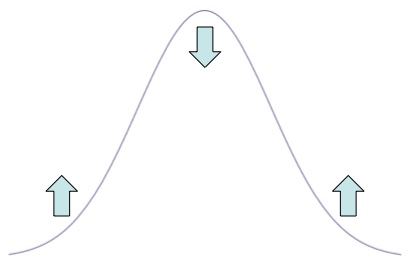
The diffusion equation dictates that if the graph is concave down, the density drops and if the graph is concave upwards, the density increases.
This is a very long-winded manner of maxim "think of estrus every bit randomly moving particles, considering the math is the aforementioned". Merely again, oestrus isn't actually particles, it's merely that picturing information technology equally such leads to useful insights. While the equation and the intuition are straight forward, really solving the improvidence equation in nigh any real earth scenario is a huge hurting.
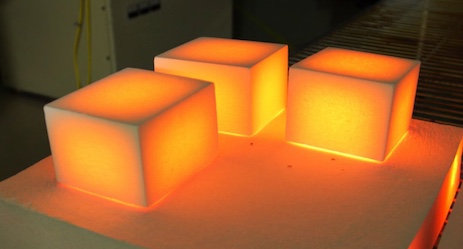
The corners cool off faster considering there are more opportunities for "rut chaplet" to fall out of the textile at that place. Although this is exactly what the diffusion equation predicts, actually doing the math by hand is hard.
It's all well and skillful to talk near how heat beads randomly walk around inside of a material, simply if that material isn't uniform or has an border, then suddenly the math gets remarkably nasty. Fortunately, if all yous're worried nigh is whether or not y'all should get out your heater on, so y'all're probably not sweating the calculus.
The shuttle tile photo is from here.
Source: https://www.askamathematician.com/2017/11/q-is-it-more-efficient-to-keep-keep-a-swimming-pool-warm-or-let-it-get-cold-and-heat-it-up-again/
0 Response to "Is It Better to Turn Heat Down and Then Up Again or Keep a Consistent Heat"
Post a Comment